NORD Scientific Symposium Full Session Recordings Available Now
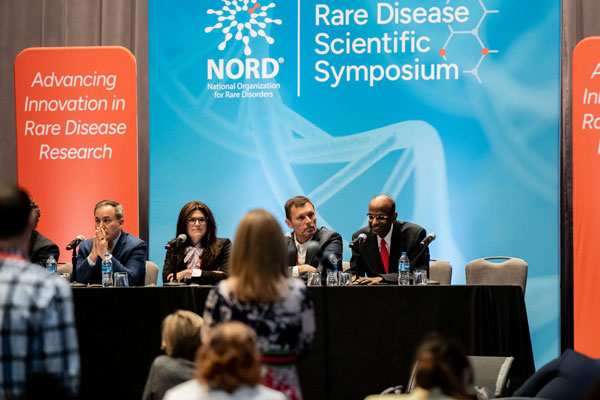
The NORD Rare Disease Scientific Symposium brought together a dynamic community of rare disease clinicians, researchers, and thought leaders for an unforgettable gathering of ideas, insights, and inspiration.
If you missed it (or want to relive it), you’re in luck: We’ve just released all full-length session recordings online! Access starts at $25 for non-attendees and is free to those who attended the event in person. Get a FREE sneak peek of three standout sessions, or purchase full access here. And keep reading for a glimpse into our inaugural Scientific Symposium.
Earlier this year, the National Organization for Rare Disorders (NORD®) convened its inaugural NORD Rare Disease Scientific Symposium in Washington, D.C., bringing together over 200 clinicians, researchers, patient advocates, regulators, and industry representatives. Over the course of two days, attendees participated in a series of presentations and conversations centered on the theme of driving progress in rare disease research through innovation and collaboration. More than 40 speakers discussed how the rare disease community is advancing new approaches to rare disease science. For clinicians and researchers, this was a unique opportunity to hear from scientific fields and medical subspecialties outside their typical area of focus.
The common thread among these differing areas of expertise was the unique challenge in conducting research in all rare diseases. This year’s event highlighted three central themes: innovation in clinical trial design, the importance of patient-centered data, and the power of collaboration. These priorities shaped a program that introduced new ideas, showcased success stories, and highlighted the urgent need for coordinated action.
Innovative Clinical Trials 
The Symposium opened with a clear call to action: clinical trials for rare diseases must evolve to meet the realities of small populations and high unmet need. In this section chaired by Dr. PJ Brooks (National Institutes of Health), speakers highlighted how adaptive platforms, basket trials, and N-of-1 strategies are being utilized in current clinical studies, and how they may apply to additional rare diseases. One of the most compelling examples came from Dr. Kiran Musunuru (University of Pennsylvania, a NORD Rare Disease Center of Excellence), who shared the story of “Baby KJ,” an infant with CPS1 deficiency who received a personalized gene-editing treatment. Dr. Musunuru introduced the concept of a master protocol IND for an “umbrella of umbrellas” clinical trial framework; this would enable more efficient testing of customized interventions using a shared therapeutic platform to treat multiple gene variants. Other presenters demonstrated how trial strategies can be tailored for rare diseases, such as disease-specific scoring to assess efficacy in complex basket trial designs. Throughout these discussions, a consistent message emerged: rare disease trials must be creative, nimble, and rooted in deep understanding of both the molecular and lived experience of disease.
Regulatory Perspective: Highlights from the FDA 
Senior FDA officials joined a plenary panel to share agency-wide insights on regulatory innovation in rare disease drug development. This panel, which featured experts from FDA’s Center for Drug Evaluation and Research (CDER) and Center for Biologics Evaluation and Research (CBER) as well as the Rare Disease Innovation Hub, provided an opportunity for direct dialogue with federal regulators. The panel addressed the growing role of biomarkers as surrogate endpoints, especially in support of accelerated approval pathways. The panelists affirmed the agency’s openness to both frequentist and Bayesian methods, noting the relevance of Bayesian frameworks for small, adaptive trials and external control data. The panel emphasized the importance of early, frequent interaction with FDA teams to navigate complex design, endpoint, and statistical issues, particularly in trials for very small populations or bespoke interventions.
The Symposium also featured a keynote address by Dr. Vinay Prasad, Director of the FDA’s Center for Biologics Evaluation and Research (CBER). Dr. Prasad (complimentary access to his session is available here) emphasized that all rare disease patients deserve access to both transformational therapies and meaningful incremental advances, and highlighted examples ranging from targeted oncology treatments to bespoke gene-editing approaches like the CPS1 deficiency “Baby KJ” case presented by Dr. Musunuru and recently featured in the New England Journal of Medicine. Dr. Prasad affirmed the FDA’s openness to innovative trial designs, real-world data, and flexibility, particularly in ultra-rare and life-threatening conditions, and underscored the agency’s commitment to transparency, responsiveness, and patient empowerment.
Patient-Centered Data and the Emergence of Artificial Intelligence 
The importance of patient-centered data collection and real-world evidence was a second theme of the Symposium. From early natural history studies to advanced use of data, multiple sessions explored how diverse data sources are shaping both research and regulatory decision-making. Presenters highlighted models that integrate longitudinal patient experience, biospecimens, and qualitative inputs such as interviews and focus groups to build rich, multidimensional datasets. These efforts aim not only to inform science, but also to align research with the priorities and realities of the rare disease community. A session chaired by Mark Skinner emphasized that registries are not endpoints, but tools to empower decision-making by all stakeholders: patients, regulators, payers, and sponsors alike. Several speakers underscored the importance of designing these systems in partnership with patients, ensuring that governance structures, data elements, and research questions reflect community needs.
The Symposium also explored the use of AI and machine learning in rare disease research. Case studies demonstrated how computational phenotyping and natural language processing can surface diagnostic insights from unstructured EHR data, while some speakers cautioned that algorithmic bias, data quality, and interpretability remain critical barriers to trust and adoption, particularly in rare conditions where datasets are sparse.
Collaboration as the Catalyst: Building Global, Cross-Sector Bridges 
In rare disease research, the power of collaboration cannot be understated. Discussions highlighted the need for multi-stakeholder, cross-border partnerships to overcome the intrinsic challenges of rare disease research, including patient scarcity, data fragmentation, and funding limitations. Speakers from Europe’s MetabERN, the Children’s Tumor Foundation, the Critical Path Institute, and ARPA-H shared how they are leveraging shared infrastructure and collaborative approaches to catalyze new discoveries. Examples ranged from multinational platform trials to community-developed disease ontologies and co-governed registries embedded in clinical care. The message was clear: no one organization or sector can solve rare disease challenges alone. By aligning scientific, regulatory, advocacy, and industry efforts, the community can not only accelerate therapeutic development but also ensure that research is meaningful, inclusive, and equitably distributed.
Looking Ahead: A Call to Stay Engaged 
As the Symposium drew to a close, what participants celebrated was not only scientific insights and policy discussions, but also the connections formed across disciplines and communities. Many attendees noted the rare opportunity to engage directly with peers from outside their usual circles, sparking new conversations and potential partnerships. Above all, the event reinforced the power of collaboration as a driver of change.
The 2025 NORD Rare Disease Scientific Symposium affirmed that the rare disease field is entering a new era, in which innovation, patient-driven evidence, and strategic partnerships are not just aspirations, but realities taking shape. We look forward to continuing these conversations in the months ahead and welcoming even more members of the rare disease community to join us next year.
See for yourself – access the Scientific Symposium video library today!